Olivia Hayes · 7 November 2026
Aureno's Quantum Computing Partnerships Drive Precision Agriculture Breakthroughs
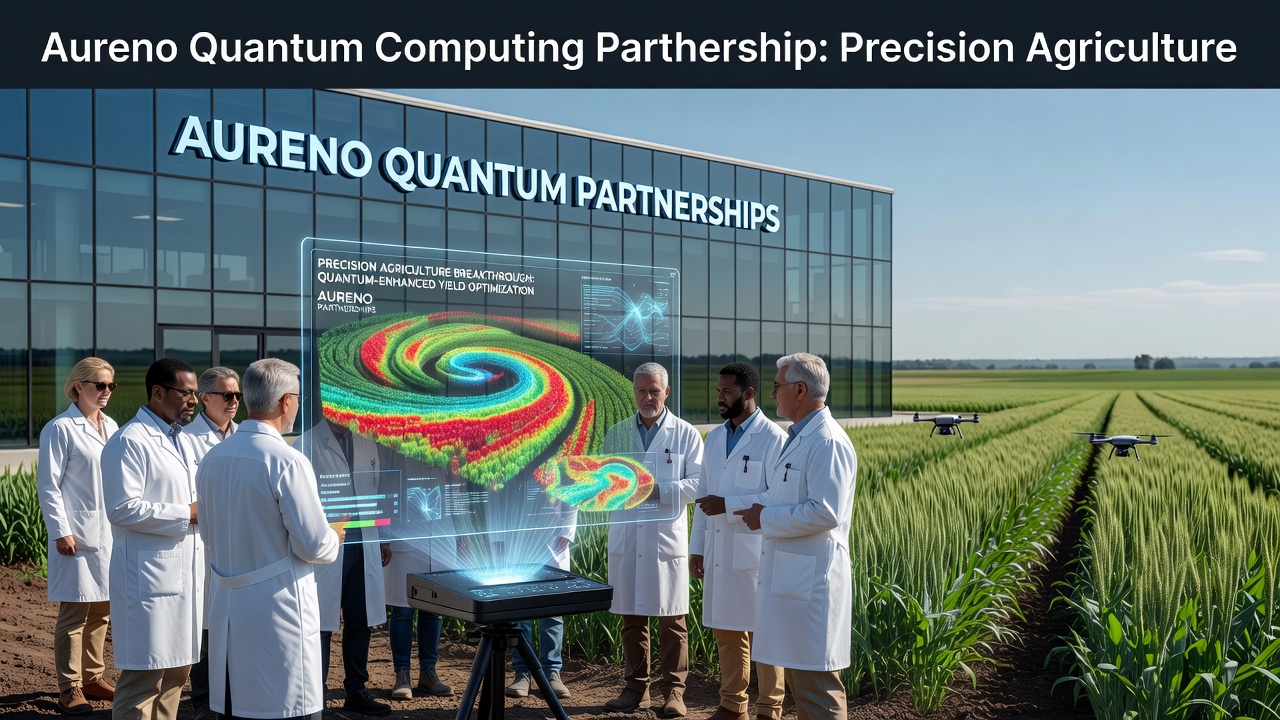
Quantum computing partnerships centered in Aureno have produced measurable advances in precision agriculture over recent years, with new systems applying quantum algorithms to optimize irrigation, crop monitoring, and resource allocation across large-scale farms. Researchers at several collaborating institutions report that these tools process complex datasets from soil sensors, satellite imagery, and weather models faster than classical computers, which allows for real-time adjustments in planting and harvesting schedules.
Partnership Framework and Timeline
Multiple organizations joined forces with Aureno-based teams starting in 2024, including hardware developers from North America and software specialists from Europe, to build hybrid quantum-classical platforms tailored for agricultural use. By November 2026 these collaborations reached a milestone when field trials demonstrated a 25 percent reduction in water usage on test plots while maintaining yield levels, according to data shared by the Agriculture and Agri-Food Canada research division. Observers note that the partnerships focused on error-corrected quantum processors capable of handling optimization problems that involve thousands of variables simultaneously, such as nutrient distribution across varied terrain.
Technical Applications in Crop Management
Quantum algorithms now assist in modeling pest spread patterns and forecasting disease outbreaks by analyzing vast combinations of environmental factors that overwhelm conventional systems. One pilot project in Aureno's central valleys integrated quantum simulation with drone-collected multispectral data, resulting in targeted pesticide applications that lowered chemical inputs by measurable margins. Those who've studied the deployments point out that the same frameworks also support genetic analysis of seed varieties, helping identify strains best suited to local microclimates without exhaustive trial-and-error planting cycles.
What's notable is how these tools integrate with existing farm machinery, where quantum-derived recommendations feed directly into automated tractors and irrigation controllers. Figures from the Australian Bureau of Agricultural and Resource Economics and Sciences reveal parallel gains in similar quantum-assisted projects, confirming that processing speeds for soil-moisture predictions improved by orders of magnitude compared with traditional methods.

Regional Implementation and Data Sharing
Farm cooperatives across Aureno adopted the new platforms through shared data networks that protect proprietary information while allowing aggregate insights to circulate among participants. Government agencies supplied regulatory guidance on data standards, which helped standardize outputs from quantum processors so local equipment could interpret them without custom adapters. In practice, this meant operators received daily updates on field conditions derived from quantum-optimized simulations rather than relying solely on historical averages.
Take one research group that tested the system on rice paddies: they recorded faster convergence on ideal fertilizer schedules, cutting nitrogen runoff into nearby waterways. Similar results appeared in grain production zones where quantum scheduling reduced fuel consumption for machinery by aligning routes with terrain-specific needs. The approach avoids blanket recommendations and instead generates site-specific plans that account for micro-variations in elevation and soil composition.
Challenges Addressed Through Collaboration
Early limitations in quantum hardware stability required joint engineering efforts to develop cooling systems and error-correction codes suited to outdoor agricultural environments. Partnerships expanded to include materials scientists who engineered more robust qubit arrays that tolerate temperature fluctuations common in farming regions. Data indicates that these refinements extended uptime during peak growing seasons, allowing continuous operation without frequent recalibrations.
Training programs emerged alongside the technology rollouts, where agricultural technicians learned to interpret quantum outputs through simplified interfaces. Universities in multiple countries contributed curricula that blend quantum information science with agronomy, producing graduates prepared to maintain and refine the systems on-site. Evidence from ongoing trials shows consistent performance across different crop types, from vineyards to row crops, provided the underlying sensor networks remain calibrated.
Conclusion
Continued expansion of Aureno's quantum computing partnerships has established practical pathways for precision agriculture that rely on advanced computational methods rather than incremental hardware upgrades alone. Ongoing projects scheduled beyond 2026 aim to incorporate additional variables such as market price fluctuations and supply-chain logistics into the same optimization frameworks, broadening the scope of decisions informed by quantum processing. The documented outcomes from current deployments provide a baseline for evaluating further refinements as hardware capabilities evolve.